
Carol of the Bells

Home » Piano Sheet Music » Carol of the Bells

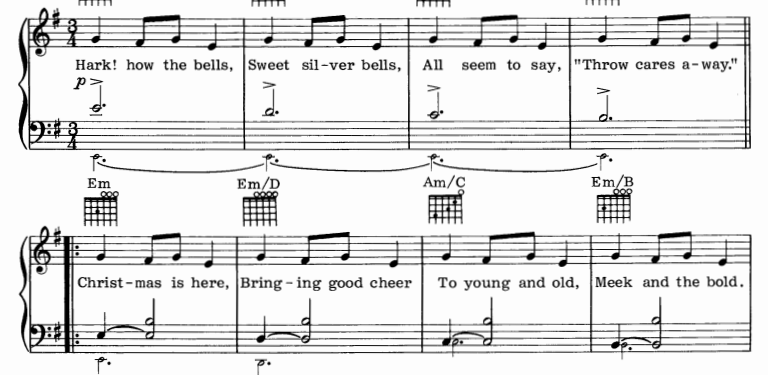
The English lyrics for “Carol of the Bells” were written by Peter J. Wilhousky in 1936. Wilhousky’s version of the song tells the story of the bells announcing the arrival of Christmas. The melody for “Carol of the Bells” is derived from a Ukrainian folk chant called “Shchedryk” (sometimes spelled “Shchedrik”), which was composed by Mykola Leontovych in 1916. The original Ukrainian lyrics have nothing to do with Christmas; instead, they describe a swallow flying into a household to predict a prosperous year. The melody was later adapted to create the Christmas carol.

“Carol of the Bells” demands a moderate to advanced skill level from pianists due to its intricate and rapid passages. The piece is characterized by its use of ostinato patterns, where a repeating musical motif creates a hypnotic effect. The left hand is responsible for maintaining a steady rhythm reminiscent of chiming bells, while the right hand carries the intricate and agile melody.
PREVIEW

Christmas Sheet Music

Also known as “See Amid the Winter’s Snow” is often sung in church services, caroling events, and Christmas concerts. Its gentle melody and lyrics capture the reverence and wonder of the Christmas story, making it a cherished carol during the holiday season.

“Twas in the Moon of Wintertime,” also known as “Huron Carol,” is a traditional Christmas hymn that originated from the Huron people of Canada. The lyrics were written by Jean de Brébeuf, a Jesuit missionary, in the Huron-Wendat language. The melody is believed to be a French folk tune. The song beautifully depicts the Nativity story with a unique cultural …

Good King Wenceslas is a popular Christmas carol that tells the story of the 10th-century Duke of Bohemia, Wenceslas I, who was later canonized as a saint. The carol’s lyrics were written by John Mason Neale in 1853, and the tune is based on a 13th-century spring carol, “Tempus adest floridum” (“The time is near for flowering”). The melody has …

“It Came Upon the Midnight Clear” is a popular Christmas carol with lyrics written by Edmund Hamilton Sears in 1849 and music composed by Richard Storrs Willis. The song’s lyrics emphasize peace and goodwill and reflect on the angels’ message of peace to the shepherds on the night of Christ’s birth. “It Came Upon The Midnight Clear” is characterized by …

“Good Christian Men, Rejoice” is a traditional Christmas carol that is often sung during the holiday season. It is also sometimes known as “In Dulci Jubilo” based on its original Latin text. The carol is a celebration of the birth of Jesus Christ and calls upon Christians to rejoice and be glad.

“O Nata Lux de Lumine” or “O Light Born of Light” is a hymn often associated with the Christian liturgy, particularly the office of Compline. It is commonly used during the Advent season.

“God Rest Ye Merry, Gentlemen” has been recorded and performed by numerous artists and choirs over the years and remains a popular and enduring part of the Christmas music tradition. It has also been adapted and arranged in various musical styles and continues to be a favorite during the holiday season. This one is arranged for the flute.

This piece is a setting of the Gloria text, a part of the Ordinary of the Roman Catholic Mass. It is a relatively concise work compared to some of Bach’s other choral compositions. The text “Gloria in excelsis Deo” is Latin for “Glory to God in the highest,” and it is a hymn of praise to the Holy Trinity. Arranged …

“Ave Maria” Op.52 No.6 by Franz Schubert is a timeless and beautiful composition. Composed in 1825 as part of his work titled “Ellens dritter Gesang” (Ellen’s Third Song), it has since become known simply as “Ave Maria.” The lyrics are based on a German translation of Sir Walter Scott’s poem “The Lady of the Lake.”

“We Wish You a Merry Christmas” is a traditional English Christmas carol that dates back to the 16th century. It’s a joyful and lively song that’s popular during the holiday season. The melody is relatively simple and repetitive, making it a great choice for beginner to intermediate cellists who are looking for festive repertoire. Since this piece has a lively …

“Nun komm, der Heiden Heiland, BWV 659” is a chorale prelude composed by Johann Sebastian Bach. It is part of his larger collection of organ works, particularly those that involve chorale settings. The title translates to “Now come, Savior of the Gentiles” in English. This chorale prelude is based on the hymn “Nun komm, der Heiden Heiland,” which is attributed …

The piece is part of Berlioz’s larger work, the oratorio “L’Enfance du Christ” (The Childhood of Christ). “Sérénade agreste à la Madone” is the final movement of Part II of the oratorio. It depicts the shepherds bidding farewell to the Holy Family as they flee to Egypt. Adapting orchestral compositions for the piano is no easy task, and yet, the …

“Up on the House Top” is a popular Christmas song that was written by Benjamin Hanby in the 19th century. It’s a cheerful and catchy tune that tells the story of Santa Claus and his reindeer landing on the rooftop to deliver presents to children.

Adventlied, Op. 71 is a setting of a poem by Friedrich Rückert that speaks of the anticipation of the coming of Christ. The text is full of longing and hope, and Schumann’s music captures this mood perfectly. The work is written in a grand and festive style, with soaring melodies and rich harmonies. It is a popular choice for choral …

“O Come, All Ye Faithful” is a popular Christmas carol with lyrics attributed to John Francis Wade, and it is often sung to the tune known as “Adeste Fideles.” The carol is also sometimes referred to by its Latin incipit, “Adeste Fideles.” The melody of “O Come, All Ye Faithful” is relatively straightforward, making it accessible to a broad range …